TrainingIntensive Language Courses (ILC)
In FY 2026, courses in Brahui and Nahuatl will be held in Tokyo. ILC is part of the training program for early-career researchers offered by the Research Institute for Languages and Cultures of Asia and Africa.
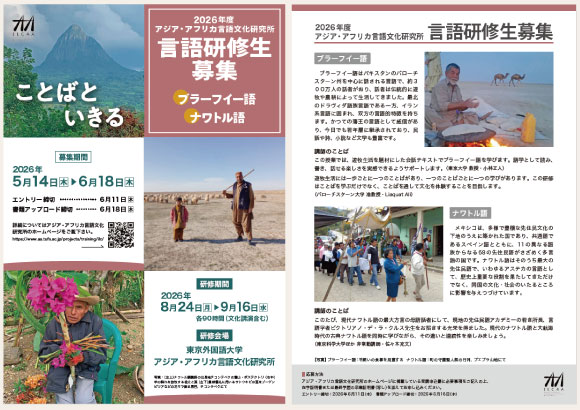
Please refer to the “Application Guidelines (in Japanese)” for details on how to apply for the intensive language course. Attendance at the course guidance and the prescribed procedures are required for TUFS students and for students eligible for mutual credit exchange.
For details, please refer to the TUFS website.
In particular, students who intend to utilize the mutual credit exchange program must register at their university and attend the guidance at ILCAA. Please ask the educational affairs division of your university for further information, including the application timeline.
Venue:
Research Institute of Languages and Cultures of Asia and Africa, Tokyo University of Foreign Studies
Dates:
August 24, 2026 – September 16, 2026 (excluding Saturday and Sunday. Total 90 hours)
AM 10:00 ~ PM 4:30
Lecturers:
Masato Kobayashi and Liaquat Ali
Venue:
Research Institute of Languages and Cultures of Asia and Africa, Tokyo University of Foreign Studies
Dates:
August 24, 2026 – September 16, 2026 (excluding Saturday and Sunday. Total 90 hours)
AM 10:00 ~ PM 5:00
Lecturers:
Mitsuya Sasaki and Victoriano de la Cruz Cruz
This program has offered intensive courses on various Asian and African languages since 1967.
The course deals with minority languages as well as national languages and/or official languages of Asian and African countries. A team of Japanese specialists and native speaker(s) instructs in each course with teaching materials they have edited. For a list of the textbooks employed in the past courses, please see Language Course Materials (in Japanese).
The expected participants are students and researchers who are pursuing Asian and African studies. They are expected to acquire not only language ability but also the expertise necessary to conduct field research and/or philological research.
The ILCAA Committee for Language Training, which consists of the instructors, ILCAA staff, and experts in language education from other institutes, organizes the courses by discussing teaching methods and implementation plans. The committee also evaluates each course after the courses have taken place.
Some courses are given at Osaka in cooperation with Graduate School of Language and Culture, Osaka University. Students are selected from applicants nationwide for each course. On successful completion of the course, the students receive certificates from the Director of the Institute.