Introducing New Staff Vol.89 : Erika KAGAWA
2026/04/13
It all began with a simple question: What is pardah?
KAGAWA, Erika
(JSPS Research Fellowship, April 2026)
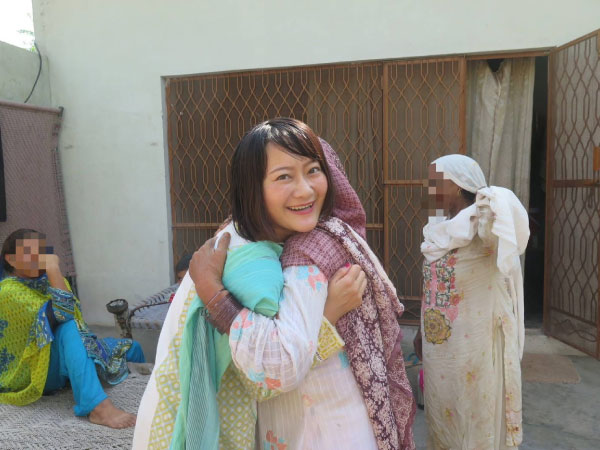
I have been studying women’s experiences of pardah in contemporary Pakistani society from the perspective of area studies. According to previous research, pardah is a norm of female seclusion widely found in South Asia—particularly in India, Pakistan, and Bangladesh—and is practiced either by separating men’s and women’s living spaces or by women creating a symbolic space of seclusion through specific forms of dress.
My interest in this topic began during my fourth year as an undergraduate, when I spent a year studying abroad in Pakistan. As a student majoring in Urdu at the School of Foreign Studies, the University of Osaka, I received support from The Konosuke Matsushita Memorial Foundation and studied at the Department of Urdu Literature at Bahauddin Zakariya University in Multan, a regional city in Punjab Province. While living in the women’s dormitory on campus, I noticed that female students significantly changed the way they dressed depending on where they were going. For example, when attending university classes, they wore an abaya—a loose coat covering the entire body—along with a headscarf (hijab) and a face veil (niqab). In contrast, when going to an off‑campus café with female friends, they removed the abaya, changed into shalwar kameez (a traditional outfit consisting of a long-sleeved shirt and loose trousers, typically accompanied by a large shawl), and went out without covering their hair.
From the standpoint of the principle of female seclusion—creating a symbolic boundary between women and men—such variations in dress could be interpreted as deviations from the norm. Nevertheless, many of these women described themselves as “practicing pardah,” which I found striking. Living alongside them, I repeatedly observed how they adjusted the way they covered their bodies or changed their clothing altogether depending on the situation. These experiences led me to feel that, in order to understand the broader context of pardah in Pakistani society, it is essential to analyze pardah through the lens of women’s everyday experiences.
With this in mind, I became interested in how women situated in diverse social contexts interpret and practice pardah. I have conducted interviews and participant observation in both urban and rural areas of Punjab Province. While my doctoral research focused exclusively on Muslim women, I am now expanding my work to include women of various faiths—Christians, Sikhs, and Hindus. My aim is to describe the everyday experiences of women for whom pardah is an important moral value, and to illuminate the ways of life that emerge from those experiences.