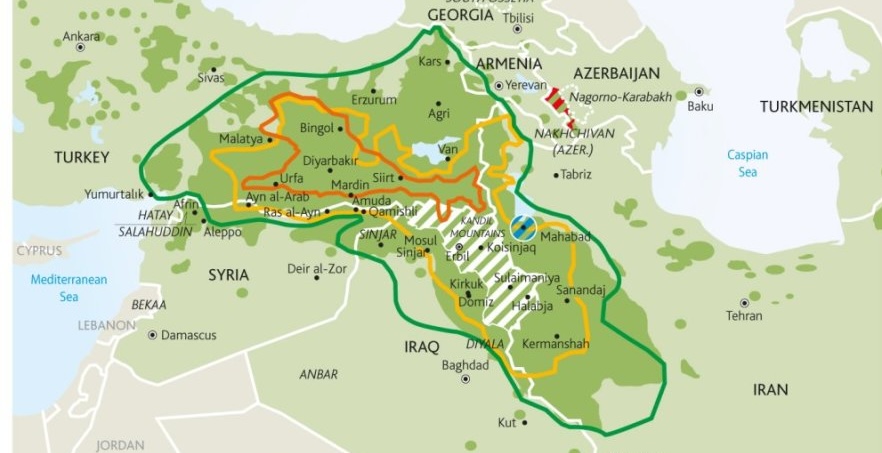
Kurdistan is often portrayed as a homeland divided by state borders. Yet borders do not merely separate; they also connect. Across the Kurdish regions of Iran, Iraq, Turkey, and Syria, social, religious, economic, and political ties continue to traverse and reshape state boundaries. This workshop explores how borders and boundaries are made, contested, crossed, and transformed in everyday Kurdish life.
Bringing together scholars working on different parts of Kurdistan, the workshop examines themes of mobility, religious networks, ethnic boundaries, and cross-border interaction. It also serves as a platform for developing future collaborative research and a proposed special issue on Kurdish borderlands and boundary-making.
Registration
- Please register by July 1, 2026, 10:00 AM JST.
The Zoom link will be sent to registered online participants.
Registration Form
Programs
| 2026/07/02 |
| 15:00 - 15:10 | Opening remarks and introduction | |
| 15:10 - 15:35 | Critical Geography and Borderlands Studies: An Alternative Framework for Studying Kurdistan? | Yasuyuki Matsunaga(TUFS) |
| 15:35 - 15:50 | Comments and discussion | |
| 15:50 - 16:15 | When Borders Are Not Margins but the Heart of the Homeland: Division, Connectivity, and the Making of Kurdistan as a Multi-Layered Suturescape | Mostafa Khalili(ILCAA-TUFS) |
| 16:15 - 16:30 | Comments and discussion | |
| 16:30 - 16:40 | Break | |
| 16:40 - 17:05 | The Unmaking of Political Borders in Kurdistan: Sufi Genealogies, Mobilisation, and the Khaznawi Tariqa across the Turkish–Syrian Frontier | Mashuq Kurt(Royal Holloway, University of London) |
| 17:05 - 17:20 | Comments and discussion | |
| 17:20 - 17:30 | Break | |
| 17:30 - 18:30 | (Closed Session for project members) Discussion of the proposed special issue, collaborative framework, and future activities. | |
Contact
Notes
For the full event program, please refer to the attached file.