- ホーム
- 進行中の研究
- 今までの研究
- 出土簡牘の生態的研究
- 額済納現地調査2009
- 額済納現地調査2013
- 居延漢簡調査
- 「肩水金関漢簡による漢代西北交通・防衛機構の研究」(青木俊介)
- 「周縁領域からみた秦漢帝国の総合的研究」(高村武幸)
- 「新出簡牘資料を用いた戦国秦から統一秦にかけての国制変革に関する研究」(渡邉英幸)
- 「最新史料に見る秦・漢法制の変革と帝制中国の成立」(陶安あんど)
- 「中国古代における 家族と「移動」の多角的研究─静態的家族観からの脱却をめざして─」(鈴木直美)
- 「三国呉・長沙の年齢史─人生の諸段階と同居家族」(鷲尾祐子)
- 「五一広場東漢簡牘よりみた後漢時代の在地社会」(飯田祥子)
- 中国古代簡牘の横断領域的研究(1)
- 中国古代簡牘の横断領域的研究(2)
- 中国古代簡牘の横断領域的研究(3)
- 中国古代簡牘の横断領域的研究(4)
- 中国古代簡牘の横断領域的研究(5)
- 資料庫実験室
- TEI2026
- 研究仲間
- 史料ノート
TEI2026 Presentation Material
The Implementation of the TEI-Guidelines on Early Chinese Excavated Administrative Documents: With a Focus on Paleographic Issues
by Arnd Hafner
Released on July 31, 2026,
under the CC BY-NC 4.0 license.
Last update on August 8, 2026.
1. The paper’s objective
As this paper aims to implement the TEI-Guidelines on early Chinese excavated administrative documents, a brief introduction into early Chinese excavated text materials is indispensable to describe the objective of this paper. Like other early writing cultures, the early Chinese world shows a variety of writing materials, ranging from turtle shells and animal bones to bronzes and to silk, bamboo, and wood. For the period from the 3rd century BCE through the 3rd century CE, we have evidence of quasi-industrial production of wooden tablets and bamboo slips, with state agencies playing crucial roles as both producers and consumers of these writing materials. The main purpose of state involvement in this production was without a doubt the creation of administrative documents and records, remnants of which have been excavated in large numbers from archaeological sites since the early 20th century. Being engaged in the research on the legal history of early Chinese states, the author of this paper (below “the author”) is one of the many beneficiaries of the findings that have been continuing up to recently[1].
Of course, the usage of wooden tablets and bamboo slips was not limited to administrative documents and records. Another important branch of writing culture was literature, ranging from philosophical treatises to practical guides and handbooks. Legal literature, such as collections of statutory laws or judiciary cases, is an important part of practical literature, often found buried in tombs together with arithmetic, medical, or divinatory handbooks. The incumbents of these tombs are predominently low-ranking local officials. A network of such officials appears to be responsible for the compilation and circulation of this unique type of practical literature[2]".
Anyone with archival experience may be aware that the concept of materiality and its significance differ largely between documents and books. Even in libraries, one can still find valuable information through book bindings, paper quality, or page layouts, etc., but the majority of library visitors concentrate on obtaining information from the written contents of books and journals. By contrast, no user of archival materials can afford to ignore the material context of the documents they handle, as this context serves as an immediate testimony to the creation, circulation, storage and/or disposal, i.e., the life-cycle, of the documents and to the processing of information conducted through these documents[3]". The same is true for early Chinese documents and literature written on wood or bamboo.
The preferred writing material for literature was bamboo, substituted by silk if deemed necessary and economically affordable. In most cases, one thin bamboo slip with a width of about 6 to 7 mm carries a single line of characters. A certain number of slips are bound together in order to create a two-dimensional writing surface capable of carrying longer texts. Just like industrial norms for paper dimensions, we are aware of varying lengths of slips tailored for various writing needs, but we also come across similar or identical texts arranged on slips of varying sizes, each with a distinct number of characters. In essence, the physical appearance of these texts amounts to a more or less random arrangement of lines and strings on a flat writing surface, very akin to texts written on paper and bound into books in the modern world. Furthermore, there is hardly any clear connection that can be established between the bamboo literature and the tombs in which most of it is discovered. At most, excavation site context information gives us some glimpses about the social status of the tomb occupant who might be the former reader or owner of the physical carrier of the literature. The question is how much information we can retrieve from the social status of a book, or scroll, owner?
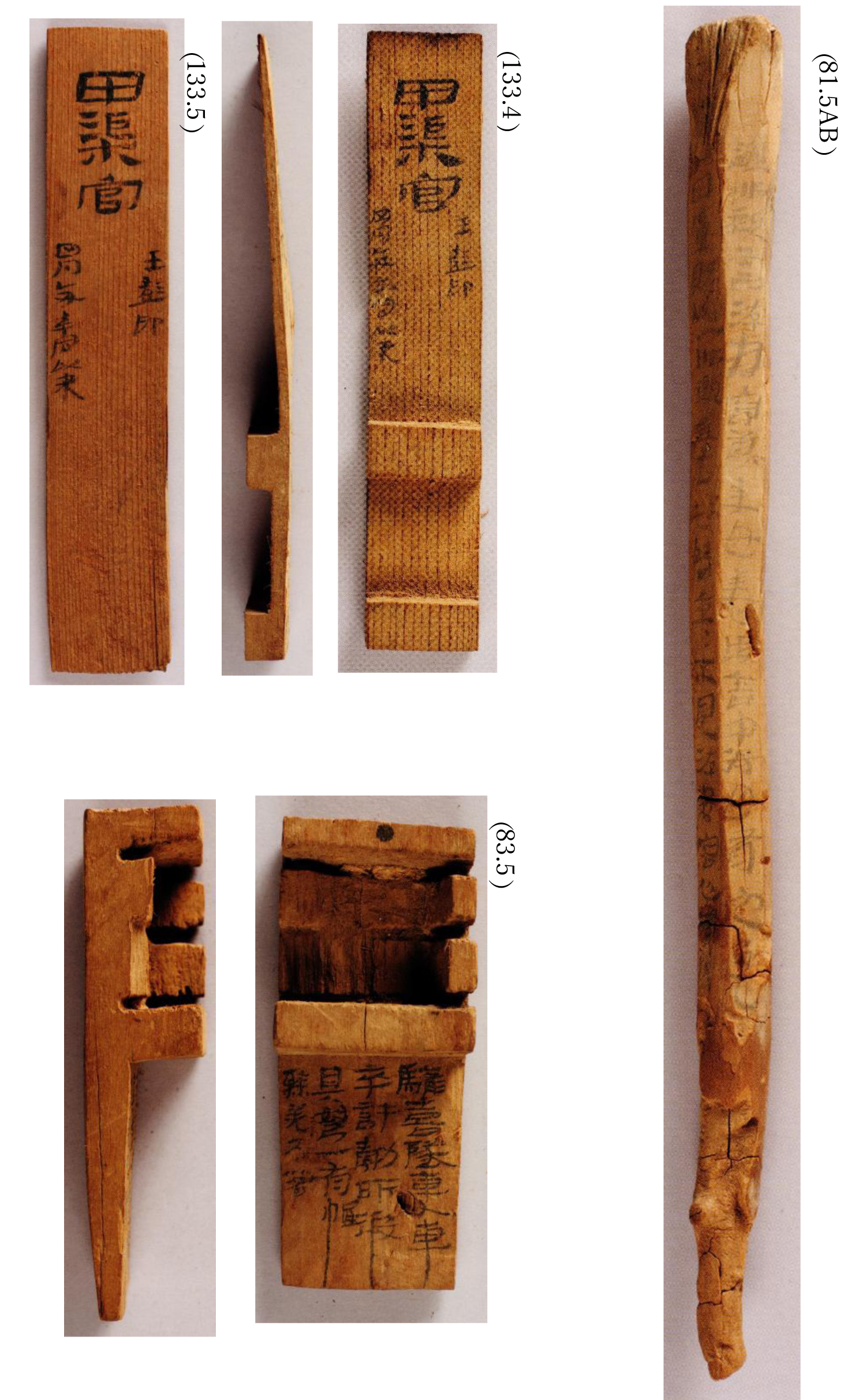
Materiality turns out to be an essentially more significant aspect in the research of excavated administrative documents. The preferred writing material was wood, which easily enabled even three-dimensional processing. Containers for sealing clay or notches and carvings on tablet sides were employed for increasing credit or conveying encrypted information, resembling magnetic tapes or digital chips found on modern plastic cards. Even on the two-dimensional surface of writing materials, the physical arrangement of different document components did not necessarily follow the physical appearance of characters from the top to the bottom or from the right to the left. While the verb shū書 merely expresses the ordinary writing of characters in textual order, the word shǔ署 was used to refer to the process of locating or arranging in a certain written form a string of characters or a particular text component, e.g. the positioning of the addressee on a tablet sealing the entire document.
A comparison of figure 1 with figure 2 and figure 3 might provide the reader with an idea of the said difference in materiality. Figure 1 shows a compilation of judicial cases from the time of the First Emperor of the Qin (Qín Shǐhuáng秦始皇, Yíng Zhèng嬴政, 259-210 BCE, r. 247-221/221-210 BCE)[4]". This compilation was based on administrative documents reporting judicial cases handled by local administrators to superior agencies, but most diplomatic features were erased, turning the original documents into linear strings of text. Traces of the binding threads that turn a group of single line bamboo slips into a broader writing surface can still be clearly recognized.
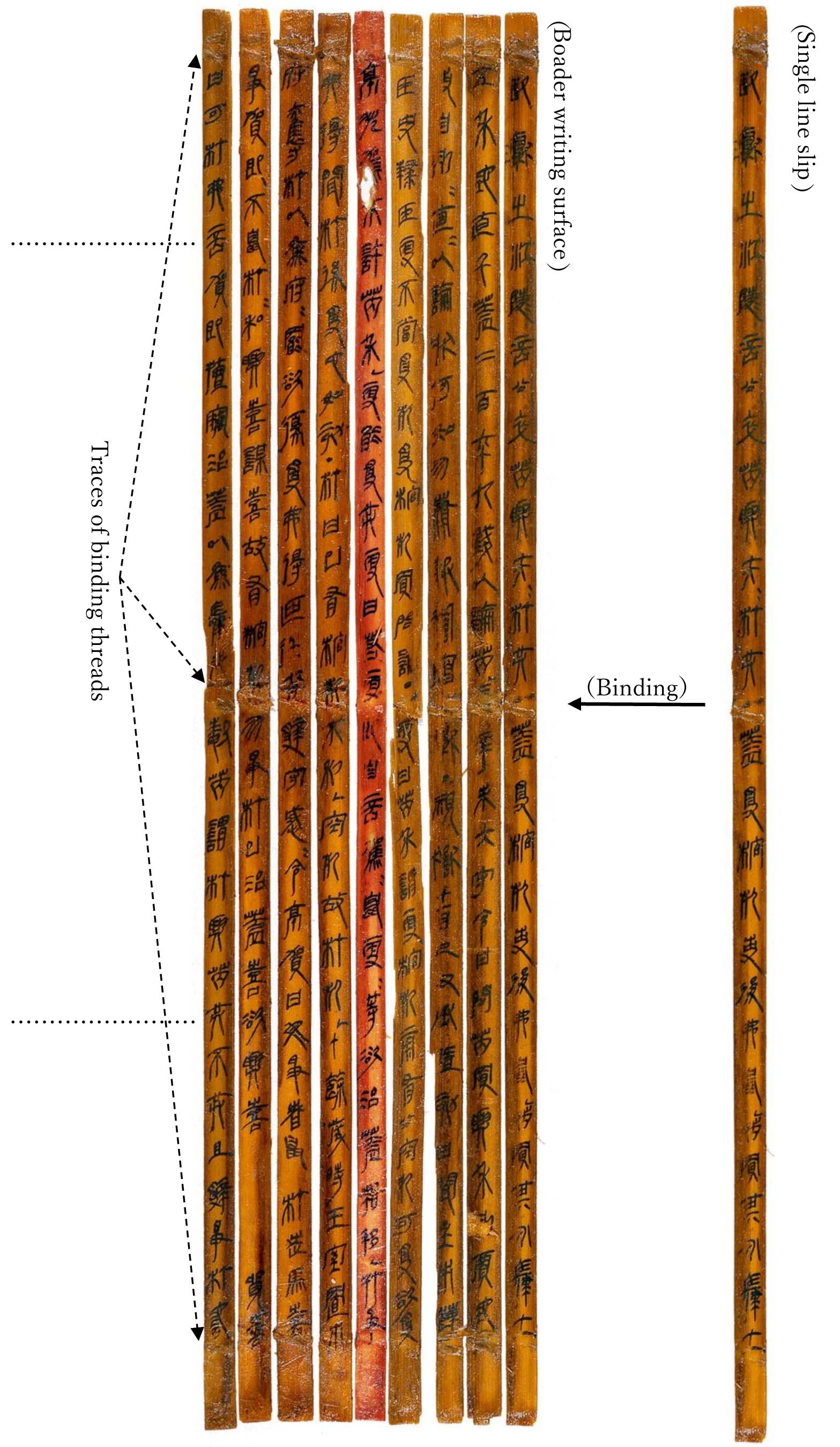
Figure 2 arranges documents of diverse shapes from the Liye-site, which also date to the time of the First Emperor[5]".
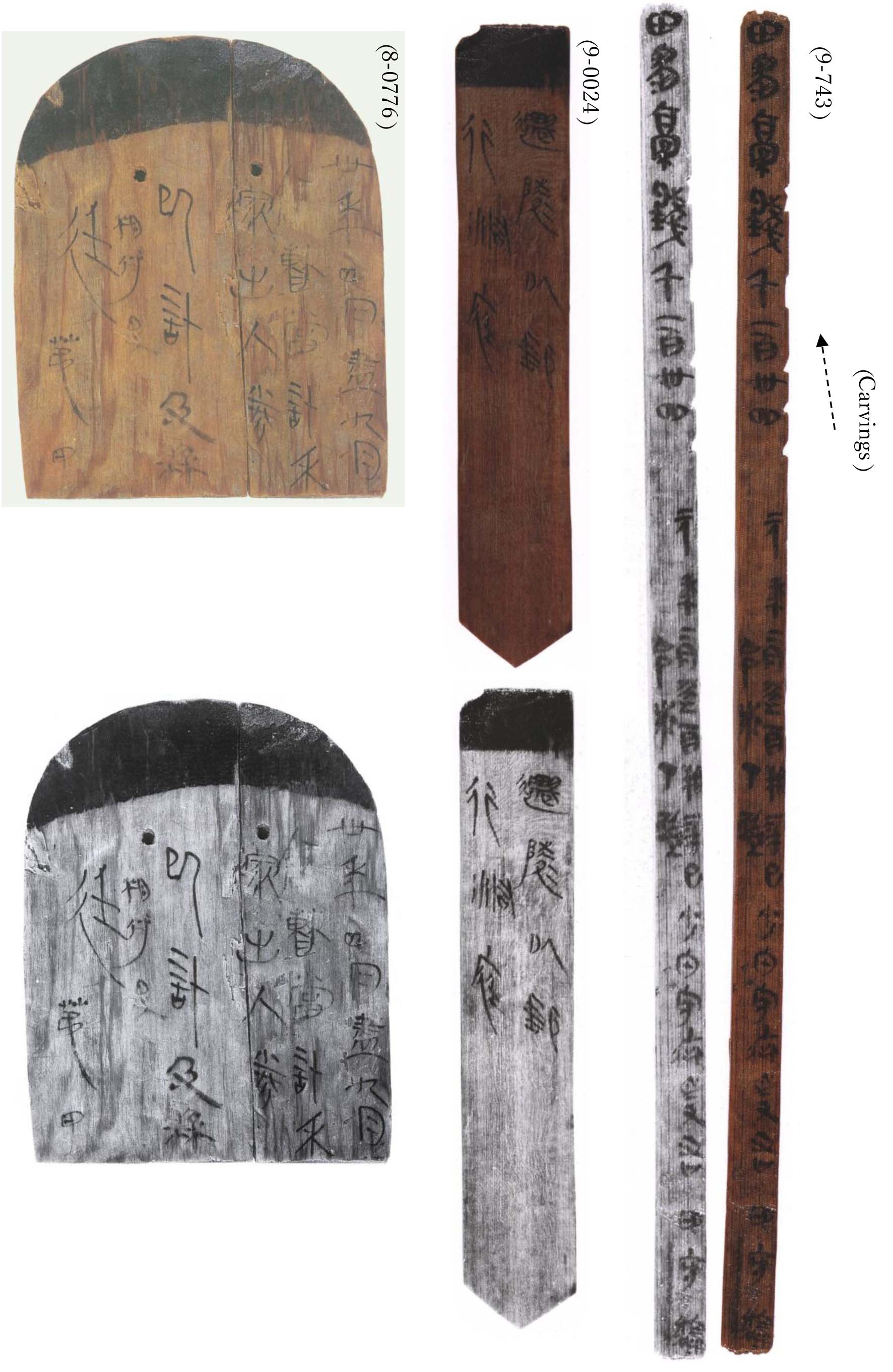
Figure 3 shows wooden tablets with three-dimensional processing features from the Juyan district, which date to a period from the middle of the Western Han to the beginning of the Later Han[6]".
For practical reasons, this paper concentrates on paleographic issues. The research on excavated literature and excavated documents is split into two specialized fields, Early Chinese Philology (Gǔ wénxiàn xué古文獻學·) and Chinese Paleo-diplomatics (Gǔ wénshū xué古文書學). The two distinct fields overlap in Chinese Paleography (Gǔwénzì xué古文字學), which is their common tool in accessing the principal literal features of their separate research objects. The implementation of the TEI-guidelines on Chinese paleography is the first essential step toward its further specialized application to the two different academic fields. Therefore, this preliminary paper restricts its scope to the common interest of the two fields. The aforementioned compilation of judicial cases dating back to the time of the First Emperor will be frequently used for demonstration purposes. For convenience, the paper will refer to it as “the compilation”.